Work/Infrastructure Project Management
2022, 2023 ✦ Design consultant
Loading...
61.2970°N 23.5025°E
© Sami Surakka 2026
Problem
Complex 3D tolerance workflows were error-prone, and the public had no visibility into project status.
Solution
Simplified expert workflows and a new public transparency tool, now in use across Nordics and Baltics.
A Finnish infrastructure startup brought me in to help simplify two complex pieces of their product offering. The first was a redesign of a technically demanding workflow for managing error tolerances. I ran a lightweight design sprint, clarified user flows, and reshaped the interaction model to reduce friction and make the process more intuitive. The second project involved creating a new tool for communicating large infrastructure projects to the public, turning dense technical information into something clear, navigable, and approachable.
It's so obvious when you see it like this.
Both efforts were well received. The client’s reaction, “it's so obvious when you see it like this” captured the goal: taking complicated material and turning it into tools that are easier to work with and easier to understand.
Video courtesy of the client. Publicly available.
The startup’s platform handled complex, highly technical workflows for infrastructure projects. One of these was an error‑tolerance flow that required users to visualize, set, and fine‑tune layered 3D data. Powerful, but hard to understand and easy to misuse.
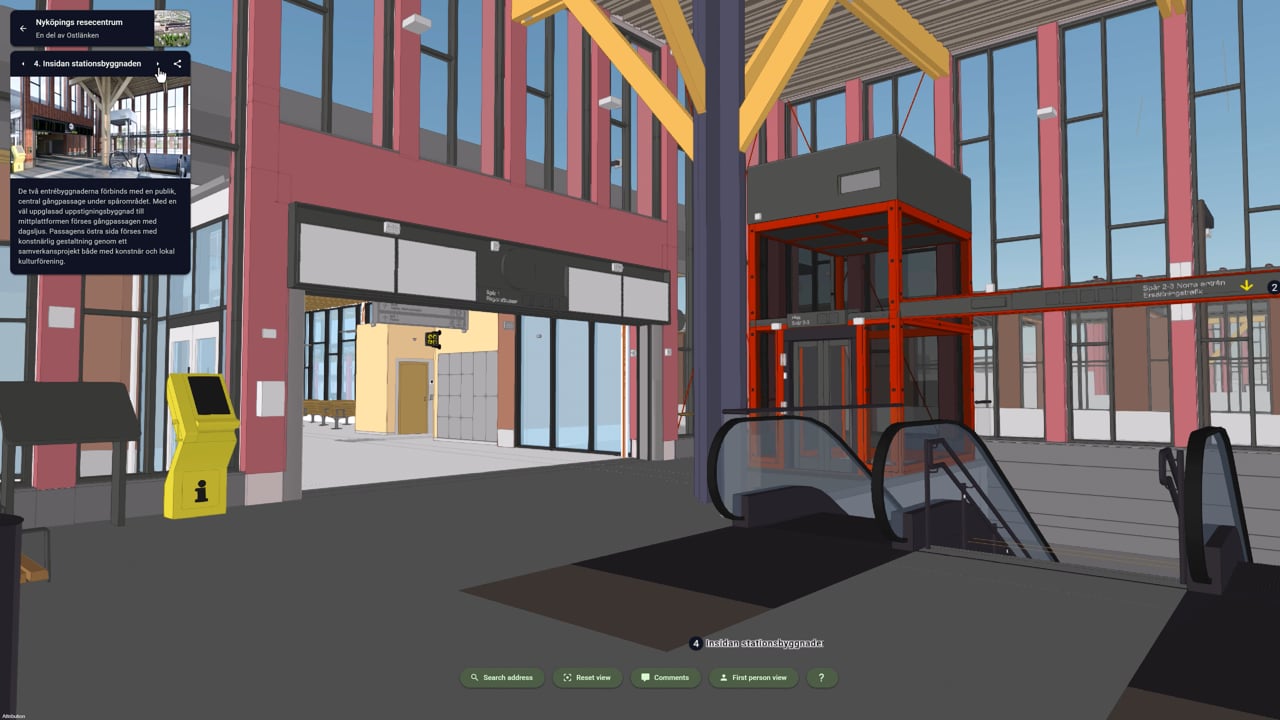
Later, the startup contacted me with another problem: there was essentially no meaningful way to keep the public informed about larger project statuses, plans, or live progress by drawing data from the project database. The public‑facing communication tool became the main end‑to‑end focus of my work.
For the error‑tolerance workflow, I ran a usability audit and provided concrete recommendations for simplifying and clarifying the interaction model so that expert users could still do what they needed, but with less friction and ambiguity. For the public communication tool, I started with a workshop to understand the goals: transparency, clarity, and a realistic level of detail for non‑experts. From there I designed an interactive prototype that pulled key information from the project database and presented it in a way that made large, long‑running infrastructure projects feel understandable and navigable. The client gathered feedback from stakeholders, and we iterated the design based on their input.
I don’t have full visibility into internal metrics, but the public communication experience has been implemented largely as I designed it and is publicly available and in use for some infrastructure projects already.
I worked as an external UX consultant. My responsibilities included running the usability audit, facilitating workshops, designing the interactive prototypes, and advising on UX decisions. The product manager handled user testing and gathering ongoing feedback from both internal and external stakeholders.
One recurring challenge in consulting work is limited long‑term visibility after handoff. I tried to follow up later to understand how the products were performing and evolving, but information was hard to come by. It was a good reminder to build in clearer follow‑up points and success criteria during the engagement itself whenever possible.